The First Stick That Sticks: Which Cigars Are Actually Converting Newcomers Into Die-Hards
Every serious cigar enthusiast has an origin story. There's always a first cigar — sometimes forgettable, sometimes transformative — that either opened a door or slammed it shut. The difference between those two outcomes often comes down to one thing: which stick was in their hand.
This isn't a casual question for the premium cigar world. The long-term health of the hobby depends on bringing new enthusiasts in, and the gateway experience is everything. Get it right and you've created a collector for life. Get it wrong — hand someone an overpowering, harshly constructed, or just plain wrong cigar for their palate — and they're out before they ever really got in.
So which cigars are actually doing the work? We dug into the conversations happening at shops, lounges, and online communities across the country to find out.
What Makes a Great Gateway Cigar
Before we get to specific names, it's worth understanding the criteria. A gateway cigar isn't just a mild cigar — that's a common misconception that leads to bad recommendations. Mild doesn't automatically mean approachable, and approachable doesn't mean boring. The best gateway cigars tend to share a specific profile:
Consistency — A first-timer can't troubleshoot a problematic draw or an uneven burn. The cigar needs to perform reliably, every time, without requiring corrective technique.
Flavor clarity — Complex is fine, but the flavors need to be identifiable. A newcomer should be able to taste something they recognize — cream, cedar, mild pepper, coffee, leather — rather than a muddy wall of sensation they can't decode.
Forgiving construction — Tight draws and canoeing are discouraging to any smoker, but they're especially damaging to first impressions. A well-constructed cigar that lights easily and burns evenly removes friction from the experience.
Finish length — A 60-ring gauge torpedo that smokes for two and a half hours is probably not where you want to start someone. A robusto or corona that delivers a complete, satisfying experience in 45 to 75 minutes respects the newcomer's attention span and tolerance.
Premium authenticity — This one matters more than people think. A gateway cigar should still feel like an event. If it's too cheap or too generic, it doesn't create the emotional association with premium culture that turns a curious smoker into a collector.
What Shop Owners Are Actually Recommending
Talk to enough tobacconists and a handful of names come up again and again when the subject of gateway cigars comes up.
Macanudo Café is probably the most universally cited entry point in the US market. It's mild, creamy, and consistent to a fault — qualities that have made it the default recommendation at shops from Portland, Maine to Portland, Oregon for decades. Purists occasionally sniff at it, but its track record of creating lifelong enthusiasts is genuinely hard to argue with.
Arturo Fuente Hemingway Short Story gets mentioned constantly by shop owners who want to give newcomers something with more personality without overwhelming them. The figurado shape, the Connecticut Shade wrapper, and the medium-bodied profile hit a sweet spot that feels premium without demanding expertise.
Montecristo White Series is another name that surfaces reliably. It's accessible, it has brand recognition that makes newcomers feel like they're smoking something legitimate, and the creamy, slightly sweet profile translates well to people who've never developed a palate for the more aggressive expressions in the premium category.
Romeo y Julieta 1875 occupies a similar space — recognizable, consistent, approachable, and available virtually everywhere, which matters when a new enthusiast wants to find their way back to something they enjoyed.
The Surprise Picks: When Medium Works Better Than Mild
Here's where the conventional wisdom gets complicated. A growing number of lounge managers and experienced enthusiasts argue that starting newcomers exclusively on mild cigars actually sets them up for a slower journey into the hobby — because those cigars don't offer enough complexity to sustain curiosity.
The argument goes like this: a truly mild cigar might be pleasant, but pleasant doesn't create obsession. Obsession comes from tasting something that surprises you, that evolves, that rewards attention. And some medium-bodied cigars do that far better than their lighter counterparts.
Perdomo 10th Anniversary Champagne is a name that comes up in this context. It's technically medium-bodied, but it's smooth, well-balanced, and delivers enough flavor evolution over its smoke time to genuinely engage a newcomer's curiosity rather than just satisfying it.
Rocky Patel Vintage 1990 is another. The box-pressed construction, the aged Nicaraguan and Honduran fillers, and the Connecticut Broadleaf wrapper combine for a profile that feels sophisticated without being intimidating. Multiple lounge regulars describe handing this to a first-timer and watching them immediately ask, "Okay, what else should I try?"
That question — "what else should I try?" — is the conversion signal. It's the moment a curious person becomes an enthusiast.
The Role of the Experience Around the Cigar
Every shop owner and lounge manager we spoke with made the same point in different ways: the cigar itself is only part of the gateway equation. The context matters enormously.
A newcomer who smokes their first premium cigar alone, without guidance, without the right pairing, and without anyone to explain what they're tasting, is far less likely to come back than someone who smokes the same cigar in a lounge with a knowledgeable friend or tobacconist walking them through it.
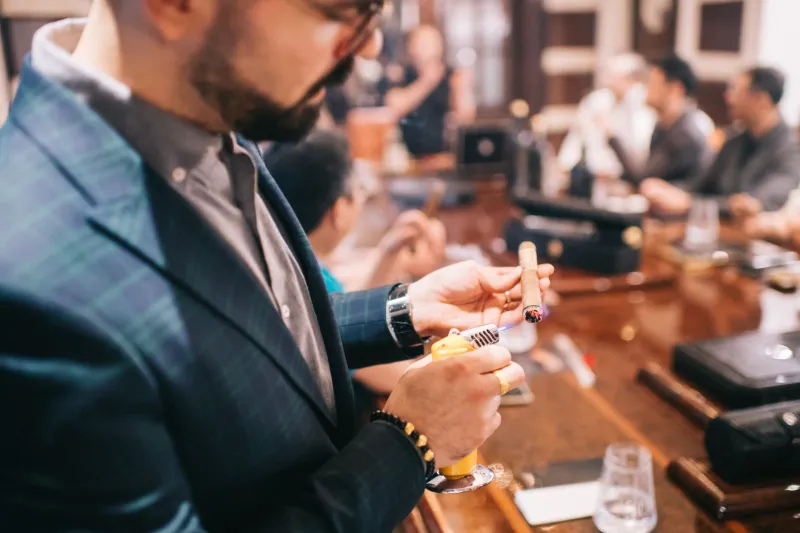
The ritual matters. The glass of bourbon or the cup of coffee paired alongside it matters. The environment matters. This is why brick-and-mortar cigar lounges remain so important to the culture — they're not just retail spaces, they're onboarding environments. A good lounge transforms a first-time purchase into a first-time experience, and those are very different things.
The best tobacconists don't just hand a newcomer a cigar — they hand them a context. They explain what to expect, what to look for, how to hold it, how to draw, when not to rush. They turn the first smoke into a lesson that makes the second smoke better.
Building a Gateway Rotation
If you're an experienced enthusiast who regularly introduces new people to premium cigars, it's worth thinking about your gateway rotation the same way you think about your personal rotation — with intention.
Have two or three reliable entry points on hand. A mild option for the genuinely cautious newcomer. A medium option for someone who seems adventurous or has some experience with pipe tobacco or other forms. And one slightly elevated choice — something like a Padron 1964 Natural in a robusto — for the person who says they want "the real thing" and means it.
Not every first cigar needs to be a gateway. But the ones you hand to people who matter — friends, partners, curious strangers at the right moment — those should be chosen with care. Because the stick that sticks isn't just their first cigar. It's the beginning of a story that might run for the rest of their life.